Fermat’s Last Theorem
Published:
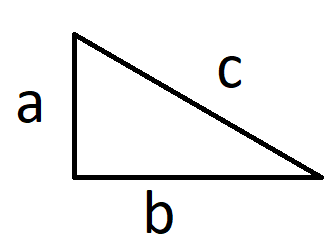
In school, we learn about the Pythagorean theorem, which is used to compute the length of any one side of a right triangle given the other two sides. We can formally express the Pythagorean theorem as \(a^2 + b^2 = c^2\), where a, b, c are the lengths of the sides of the triangle and c represents the hypotenuse.
If we generalize the formula for different powers, we get \(a^n + b^n = c^n\). Unlike the Pythagorean theorem, this generalized equation does not have three definite (non-zero) integer values for a, b, and c when \(n\) is greater than 2. This is known as Fermat’s Last Theorem, which was later proved by other mathematicians.
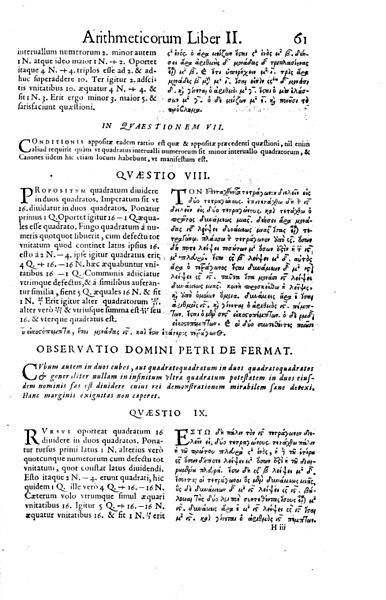
Fermat’s famous note in the margin of his copy of Diophantus’ Arithmetica:
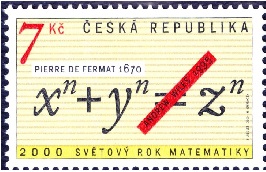
The Czech Republic also released a postage stamp commemorating Andrew Wiles’ proof of Fermat’s Last Theorem: